

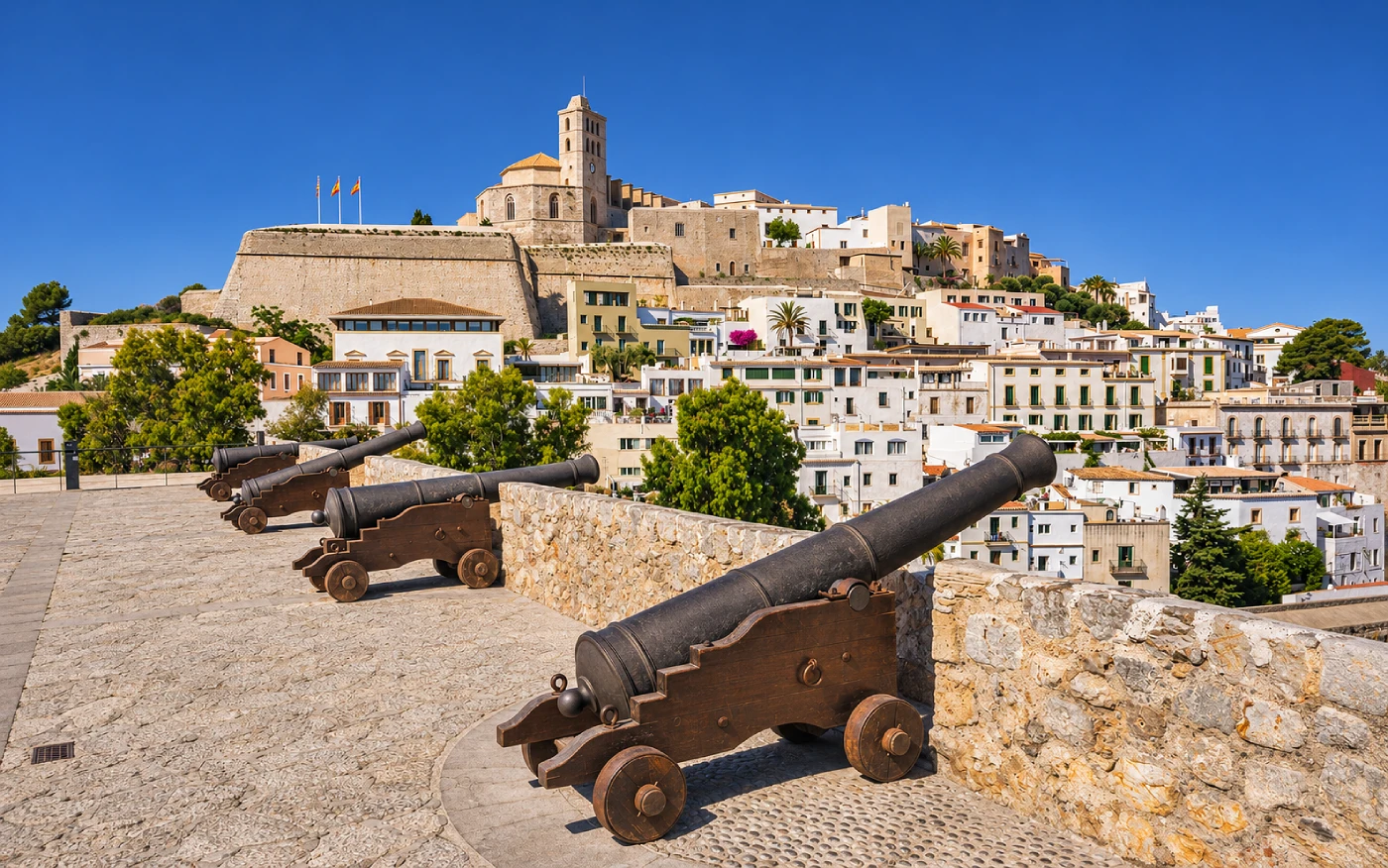
High above the harbour of Ibiza Town rises Dalt Vila, the walled “upper town”. Since 1999 it has been part of the UNESCO World Heritage Site “Ibiza, Biodiversity and Culture”, together with the necropolis of Puig des Molins, the Phoenician settlement of Sa Caleta and the island’s Posidonia meadows.
What it’s like
The walls you see today were built in the 16th century, to a design largely by the Italian military engineer Giovanni Battista Calvi, to protect the town from Ottoman and pirate attacks. They run for about two kilometres around the hill, with bastions that now serve as viewpoints.
Inside, steep cobbled streets lead past whitewashed houses and old palaces to the top of the hill, where the cathedral of Santa Maria de les Neus and the castle stand side by side. Begun in the 14th century, the cathedral mixes Gothic and Baroque, and its terrace looks out over the whole bay.
What to see and do
Enter through the Portal de ses Taules, the main gate, reached by a stone ramp and flanked by Roman statues. Walk up to the cathedral, then follow the walls round to the bastions for the views, especially at sunset from the western side. Inside the walls are the Museum of Contemporary Art (MACE) and the Archaeological Museum. The MACE opens Tuesday to Friday from 10am to 2pm and from 6pm to 9pm, and at weekends from 10am to 2pm; it is closed on Mondays. Walking the streets and the walls is free.
Every year, usually over a weekend in the second week of May, Dalt Vila hosts a medieval fair, when the old town fills with stalls, music and costumes. The exact dates change from year to year.
Getting there
Dalt Vila is a ten-minute walk from the harbour. Cars are restricted inside the walls, and parking nearby is difficult in summer, so walk up from the port.
Good to know
The streets are steep, cobbled and often stepped: wear comfortable shoes. They are not suitable for pushchairs or wheelchairs in most places. In July and August, come before 10am or after 5pm to avoid the heat.